How a meeting of kings beside the River Eamont, and a baptism at Dacre, helped shape a nation
Almost eleven hundred years ago, the valley where St Andrew’s Church now stands was part of an important moment in British history. In the summer of 927, King Athelstan of Wessex met the rulers of the north beside the River Eamont, about a mile from our church[1]. They made a peace there that many historians see as the moment England first came together as one kingdom[2]. According to one medieval historian, part of that story took place here at Dacre.
A Divided Island
In the early tenth century, Britain was made up of many separate kingdoms. Wessex controlled much of the south. Viking kings ruled from York. The Lords of Bamburgh held what was left of the old kingdom of Northumbria. To the north and west lay the kingdoms of the Scots, Strathclyde (which then reached down into what is now Cumbria) and the Welsh[3]. Athelstan, grandson of Alfred the Great, became king in 924. When Sihtric, the Viking king of York, died in 927, Athelstan took control of York and turned his attention to the rest of the north[2][3].
The Meeting at Eamont, 12 July 927
The Anglo-Saxon Chronicle, written in a northern monastery soon after the event, records that Athelstan brought under his rule the kings of the island: Hywel of the West Welsh, Constantine of the Scots, Owain, and Ealdred, son of Eadwulf of Bamburgh[4]. Most historians think this Owain was the King of Strathclyde[1]. The Chronicle says they met at a place called Eamotum, at the River Eamont, on 12 July 927. There they made peace with pledges and oaths and agreed to renounce idolatry, which probably meant promising not to ally with the pagan Vikings[1][4].
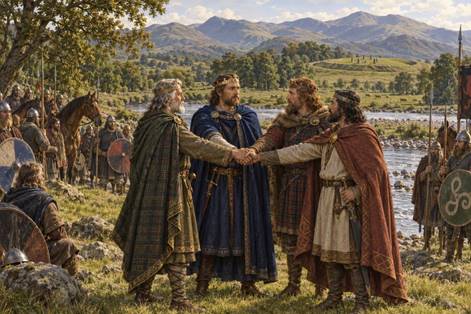
The kings swear peace beside the River Eamont, 12 July 927. (AI-generated illustration).
The land between the Rivers Eamont and Lowther had been used as a meeting place since long before the Romans came. Ancient monuments such as Mayburgh Henge and King Arthur’s Round Table still stand there today[1][3]. It was also on the border between Athelstan’s new lands and the kingdom of Strathclyde, which made it a natural place for rulers to meet on equal ground[3].
Why Dacre?
About two hundred years later, around 1125, the monk and historian William of Malmesbury wrote about the meeting in his Deeds of the Kings of the English[1][5]. He said that Constantine, King of the Scots, and Owain of Strathclyde came to Athelstan “ad locum qui Dacor vocatur”, meaning “to the place which is called Dacre”, and gave themselves and their kingdoms into his care. He also wrote that Constantine’s son was baptised there “at the sacred font”, with Athelstan himself standing as godfather[5][6].
“…to the place which is called Dacre” (William of Malmesbury, c. 1125)
Historians still disagree about exactly where the treaty itself was agreed. William may have been using an older source that has since been lost[1]. But a baptism needed a church and a font. At the time, the nearest important religious house to the Eamont crossings was the monastery at Dacre, so it is quite likely that the christening took place here[6]. The baptism also mattered politically. It made the agreement more than a show of power. It bound the two royal families together as godfather and godson and presented the peace as a Christian alliance.
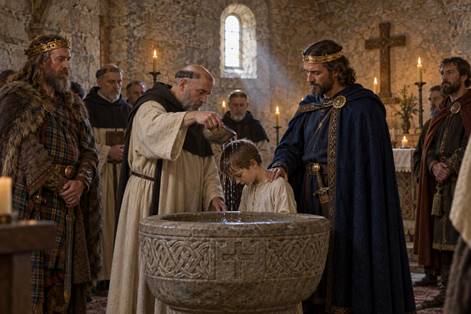
Constantine’s son is baptised at the font, with King Athelstan standing as his godfather. (AI-generated illustration)
.
The Monastery at Dacre
Dacre had been a place of prayer long before 927. In his Ecclesiastical History of the English People, completed in 731, the Venerable Bede describes a monastery beside the River “Dacore”, which took its name from the river. He tells how a young monk there was cured of a painful growth on his eye after touching a lock of St Cuthbert’s hair, which the monastery kept as a holy relic. Bede heard the story from Thrydred, the Abbot of Dacre himself[6][7].
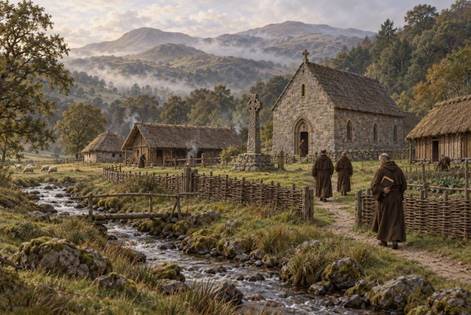
The early monastery at Dacre, as it may have looked in Bede’s time. (AI-generated illustration).
Excavations in 1929 and in 1982–85 found evidence that the present Norman church stands on the site of that early monastery. The finds included early graves, a Viking-age coin, other objects from before the Norman Conquest, and a substantial stone-built drain, probably made with stones reused from a Roman bridge. In 2022, Oxford Archaeology published a full account of the excavations as The Early Medieval Monastic Site at Dacre, Cumbria[6].
Clues in Stone
Visitors can still see links to Dacre’s early history inside the church. Two carved fragments survive from the period. One is part of an early ninth-century cross-shaft carved with a vine scroll, with human figures climbing among the branches and a lion-like beast in the foliage. It belongs to the great tradition of Northumbrian stone carving[6][8]. The other is a slightly later tenth-century slab, found built into the east wall of the chancel during restoration work in 1875. Because some people thought its carving showed the events William of Malmesbury described, it is known as the Dacre Stone[6].
In the churchyard stand the famous Dacre Bears, four weathered stone carvings. Some people now think they are lions rather than bears. Their origin is still a mystery. Local tradition has long asked whether they mark the places where the four kings stood[9]. They remain one of the best-loved puzzles of Dacre.
 |  |  |  |
Why 927 Matters
The meeting of 927 is often described as the birth of England. After it, Athelstan’s royal title changed. Earlier kings had called themselves “King of the Anglo-Saxons”, but Athelstan became Rex Anglorum, “King of the English”[2][3]. His coins began to carry the title “King of the Whole of Britain”. A Latin poem written at the time even declared that the land was now “made whole”[1][2]. For the first time, all the English peoples were united under one king. And part of that story was written here, in the quiet valley of the Dacre Beck.
Celebrating 1,100 Years in 2027
12 July 2027 marks 1,100 years since the meeting at Eamont. As part of the anniversary programme run by the Eamont 927 partnership, St Andrew’s will hold a special service on Monday 12 July 2027 at 3:00pm. The service will echo the baptism of Constantine’s son, the christening that bound together the royal families of England and Scotland 1,100 years ago. A memorial plaque has also been commissioned to mark this anniversary[10].
Visit Us
St Andrew’s Church is open to visitors throughout the year, normally the Church is open between 09:00 and 17:00. Services are held most Sundays at 09:30.
You can see the carved stones inside the church, look for the Dacre Bears in the churchyard and spend time in the peace of a place where people have prayed for nearly 1,300 years.
The church lies on the Ullswater Way (Dalemain Loop), about five miles from Penrith[9]. It makes a good starting point for exploring the Eamont valley, where the kings met in 927.
Find Out More
- The Meeting at Eamont in 927 (Eamont 927 partnership)
- 1,100th anniversary service at St Andrew’s, Dacre (Eamont 927 partnership)
- The Early Medieval Site at Dacre, Cumbria (Oxford Archaeology)
- History of St Andrew’s Dacre (This Web Site)
References
- Eamont 927 (n.d.) The Meeting at Eamont in 927. Available at: https://www.eamont927.co.uk/history/ (Accessed: 13 October 2026).
- Foot, S. (2011) Æthelstan: The First King of England. New Haven, CT and London: Yale University Press (Yale English Monarchs).
- England’s 1100th (n.d.) 927: Overview of Events in 927. Available at: https://www.england1100.co.uk/927 (Accessed: 13 October 2026).
- The Anglo-Saxon Chronicle, According to the Several Original Authorities (1861) Vol. 2: Translation. Edited and translated by B. Thorpe. London: Longman, Green, Longman, and Roberts. Manuscript D, annal for 926 [recte 927].
- William of Malmesbury (1998) Gesta Regum Anglorum: The History of the English Kings. Vol. 1. Edited and translated by R.A.B. Mynors, R.M. Thomson and M. Winterbottom. Oxford: Clarendon Press (Oxford Medieval Texts). Originally written c. 1125.
- Newman, R.M., Howard-Davis, C. and Leech, R.H. (2022) The Early Medieval Monastic Site at Dacre, Cumbria. Lancaster: Oxford Archaeology North (Lancaster Imprints, 30). Appendices available at: https://eprints.oxfordarchaeology.com/6183/ (Accessed: 13 October 2026).
- Bede (1969) Bede’s Ecclesiastical History of the English People. Edited and translated by B. Colgrave and R.A.B. Mynors. Oxford: Clarendon Press (Oxford Medieval Texts). Originally written 731. Book IV, chapter 32.
- Bailey, R.N. and Cramp, R. (1988) Corpus of Anglo-Saxon Stone Sculpture. Vol. 2: Cumberland, Westmorland and Lancashire North-of-the-Sands. Oxford: Oxford University Press for the British Academy.
- St Andrew’s Church, Dacre (n.d.) History. Available at: https://dacrechurch.com/?page_id=18 (Accessed: 13 October 2026).
- Eamont 927 (n.d.) Church Service. Available at: https://www.eamont927.co.uk/whats-on/events/church-service/ (Accessed: 13 October 2026).
Jeremy Mead (& AI from Microsoft Copilot)